Thursday, October 4, 2012

Gods In The World Of Men: The Destroyer

Man: The Destroyer
Man creates images through his own impulses seeded within, gathered by his experience all through in the nature, 
installing and worshiping them and then making a sacrifice as destroying it by immersing in the river-water.
(part of 'Lord Ganesha' festival)

Psychologically hard to fathom these secret-pits of human innards.

  
* That's how it is visible in some more manifestation of his such desires unknown, all through the human history....all across the world !!
 
Lord Ganesha idol submersion in river-water.
torn and neglected idols of Lord Ganesha after the festival

# The concept of three Gods in 'Hindus' from India: the 'Creator' (Brahma), the 'Preserver'(Vishnu), and the 'Destroyer'(Mahesh), seems to be the manifestation of imagination of human's deep hidden desires in their psyche, and that is to 'create', to 'worship' and to 'destroy'....

Composite Image of Brahma, Vishnu and Mahesh


# The Trinity is considered to be a mystery of Christian faith.

The earliest known depiction of the Trinity, Dogmatic Sarcophagus, 350 AD Vatican Museums.


# THE EARTH GODS

      by Kahlil Gibran

      Imagination of three earth Gods, namely the creator, the preserver and the the destroyer of kind.

When the night of the twelfth aeon fell,
And silence, the high tide of night, swallowed the hills,
The three earth-born gods, the Master Titans of life,
Appeared upon the mountains.

Rivers ran about their feet;
The mist floated across their breasts,
And their heads rose in majesty above the world.

Then they spoke, and like distant thunder
Their voices rolled over the plains.

(opening stanzas from this great book of the 'Gibran'.)


# Photos of atomic bomb mushroom clouds, over two Japanese cities in 1945; could never be explained without understanding these hidden mischievous psychic traits of humans, i.e. the destruction of it's own kind-creation to whom once he loved so much !!


Little conclusions:  

* In general we humans are a case of multiple personality (layers) symptoms, at most often. 

* Some little reasons (personal, social, religious etc.) proves to be an 'on switch' for the shuffle. 

* As personality  word is derived from Latin, where it originally referred to a theatrical mask (The Latin word probably derived from the Etruscan word "phersu", with the same meaning, and that from the Greek πρόσωπον (prosōpon). So the personality is the mask we bear....
* If a mask is replaceable , so be the personality....   

Strange Case of Dr Jekyll and Mr Hyde is the original title of a novella written by the famous Scottish author Robert Louis Stevenson that was first published in 1886.

*Note: all pictures thankfully shared from various sources..


Thursday, September 27, 2012

Gods In The World Of Men: The Worshiper

Man: The Worshiper
Human imagination creates.... 
and then comes that part where he bows down to his own images by installing and worshiping them amidst all his busy worldly businesses..
(part of 'Lord Ganesha' festival)

Wednesday, September 19, 2012

Gods In The World Of Men: The Maker

Man: The maker
India is a land of much festivity attached with various Gods to be worshiped in a particular month, season or a period set for them.
And it is so interesting that man makes God images through their own hands with the soil and imagination been endowed by their own God in turn, to worship and later to destroy these clay images by immersing it in river water....
Such a festivity starts today !!
 (part of 'Lord Ganesha' festival)

Wednesday, September 12, 2012

Abandoned Places: Rajim Temples

The poetry of forgotten places 
I knew there are many villages, farms and just lonely houses all around the world but when thousands of people leave, leaving the whole city dead that’s a real tragedy. There are mainly two reasons why people suddenly or little by little leave the place where they used to live for years or even generations: that’s the danger and economic factors. And things become more critical when we find rich cultural heritage of thousand years old, just left behind, obviously for no reasons ?
Ride back in time 
In any case, that’s the history we should know about, so let's get started. 
You'll learn about bustling sea ports, prosperous centres of trade, beautiful houses of worship and powerhouse capital cities of great empires. Although these cities eventually fell to war or natural disaster, their legacies live on in majestic temples preserved as World Heritage Sites or transformed into museums and galleries, sophisticated art pieces and modern day reliance on the knowledge and age-old techniques developed by the citizens of ancient cities in agriculture, bead-making and metallurgy. So............hop on and enjoy the ride back in time.
Rajim
The holy confluence of three rivers Mahanadi (Chitrotpala), Pairi and Sondur, called Triveni Sangam is at Rajim. Rajim is also known as the "Prayag" of the Chhattisgarh.
 A holy pilgrimage centre, Rajim, is situated on the southern bank of Mahanadi river where Pairi and Sondhur rivers meet with Mahanadi. Rajim is also addressed as "Prayag Raj of Chhattisgarh". The ancient name of this place was Kamal-Kshetra or Padmapur. Lord Vishnu is being worshipped here in Rajiv Lochan temple. Rajeshwar, Daneshwar and Ram Chandra temple are important temples in the group. Kuleshwar Mahadeo Temple, situated at the confluence (संगम स्थल) is built on a raised platform. It faces the east direction and belongs to 9th cent. AD. The temple consists of sanctum, anti-chamber and mandapa. A stone inscription of Kalchuri Jagpal or Jagat Deo is fixed on the wall of Mandapa. This is a fine example of regional art and architecture. 
Location of Rajim
in Chhattisgarh and India
Coordinates 20°57′54″N 81°52′54″ECoordinates: 20°57′54″N 81°52′54″E
Country India
State Chhattisgarh
District(s) Raipur
Nearest city Raipur
Time zone IST (UTC+05:30)
Area
Elevation

281 metres (922 ft)

Rajivlocan Temple
More than a thousand years old, Rajim's Rajiv Lochan Temple has its origins in mythology...
One fine day, Lord Vishnu made a tricky demand - he asked Lord Vishwakarma to find a place on earth where nobody was ever cremated within a five-mile radius. lord Vishnu wanted a temple built there. It was an arduous task, and Lord Vishwakarma failed to find the fabled land. An exasperated Lord Vishnu then picked up a lotus and proclaimed that his temple would be built wherever the lotus fell. the drops of nectar fell in Rajim, exactly where the famous Rajiv Locahn temple stands, while the five petals became part of what is known as Panchkoshi Dham - Kuleshwar, Fingeshwar, Kopeshwar, Patneshwar and Pateshwar.

When you walk the mud spattered lanes of this sleepy town. it seems incredible that once upon a time Rajum was the most important urban centre of the Mahakoshal region. You would perhaps grant Rajjim its religious statue more willingly and happily. All you have to do is walk by the Mahanandi and watch its expanse mingling with Pairi and Sondhu. It is this confluence that gives Rajim the sobriquet of Chhattisgarh's Prayag. The town has been names after Rajim Telin. Mythology has it that Lord Vishnu, pleased with her devotion, promised that her temple would be the first in Rajim.

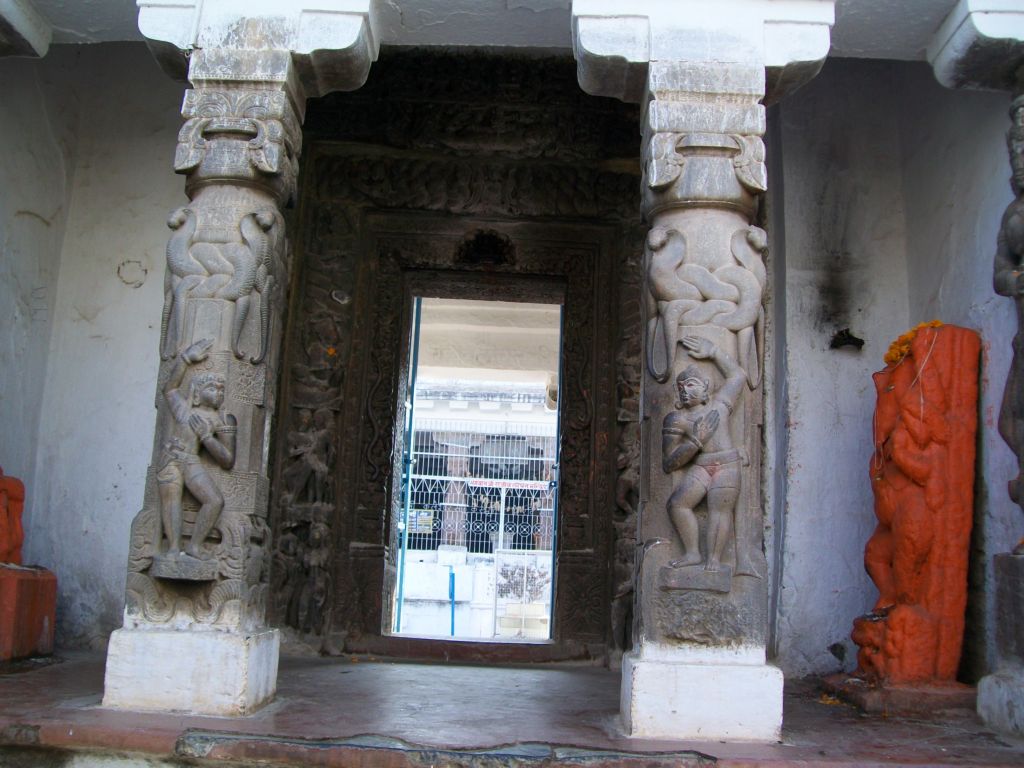
Built almost 1,300 years ago, the Rajiv Lochan Temple has 12 pillars, each carved intricately with just one figure; for generation it is the Kshatriyas who have been the temple's priests; it has a rare idol of a barefoot Lord Vishnu made of black granite; no mantras are recited during the shringar puja and the idol is dressed up like a child in morning, as youth in afternoon and as old man in the evening; for generations the same family has been weaving the pagri that adorns the deity. If you can believe this, the walls of the temple are made of bricks that have been held together with a mixture of limestone, urad dal and the entrails of the wood apple. And not one brick has moved or cracked in these 1,300 years!

None of this hearsay, though. In his report, Sir Alexander Cunningham, the first director general of the Archaeological Survey of India, mentions Rajim as a complex of ancient temples. It is during the Rajiv Locahn Festival, held between February 16 and March 1, that Rajim is at its holiest. Thousands of people throng this sleepy village to take a dip in the Triveni Sangam, offer their prayers at the Rajiv Lochan Temple and carry back the hope of salvation.

Sunday, September 9, 2012

Abandoned Places: Bhoramdeo Temples

The poetry of forgotten places 
I knew there are many villages, farms and just lonely houses all around the world but when thousands of people leave, leaving the whole city dead that’s a real tragedy. There are mainly two reasons why people suddenly or little by little leave the place where they used to live for years or even generations: that’s the danger and economic factors. And things become more critical when we find rich cultural heritage of thousand years old, just left behind, obviously for no reasons ?
In any case, that’s the history we should know about, so let's get started.
Bhoramdeo Temple  
..is a very old Hindu temple dedicated to Lord Shiva and is located at a distance of 18 km from Kawardha town in Kabirdham district in the Indian state of Chhattisgarh. This temple, scenically situated amidst mountain ranges, was built in the period of 7th to 11th century AD. The temples were built by King Ramchandra of the Nag Dynasty and have a special attraction for lovers of history and archaeology.
Amidst the picturesque surroundings of Maikal mountains and dense forests, the perfect blend of religious and erotic sculptures, the Bhoramdeo temple, is carved on the rocky stones in the Nagar style. The Shiva Linga in the temple is beautifully carved and the artistic appeal beckons the visitors. The Bhoramdeo temple has a resemblance with the Khajuraho temple, and that is why it is also called the Khajuraho of Chhattisgarh. In the backdrop of natural beauty, this temple is also unique for its architecture. Cunnigham had termed it as one of the most beautifully decorated temple seen by him


Geographical Information for Bhoramdeo
Place name: Bhoramdeo
Latitude: 22° 09' 59" N
Longitude: 81° 18' 12" E
Feature description: town
Region: Kawardha
Area/state: Chhattisgarh
Population range of place: is between 10,000 and 20,000
Country: India
Country ISO code: IN