Thursday, December 6, 2012

Premier Indian institution: Forest Research Institute

The Forest Research Institute is an institute of the Indian Council of Forestry Research and Education and is a premier institution in the field of forestry research in India. It is located at Dehradun in Uttarakhand, and is one of the oldest institutions of its kind. In 1991, it was declared a deemed university by the University Grants Commission.

History: Founded in 1878, as the British Imperial Forest School,[2] by Dietrich Brandis.
In 1906, reestablished as the 'Imperial Forest Research Institute', under the British Imperial Forestry Service.
The 'Indian Forest College' was established in 1938; officers recruited to the Superior Forest Service by the states and provinces were trained there.


Dehradun railway station building bearing the year 1899
Dehradun railway station still bears structural impacts of British colonial architectural look
Bird's eye view of the FRI campus. Picture thankfully shared
FRI as illuminated in night. Picture thankfully shared
FRI as on Indian postage stamp
Beautiful staff cottages in FRI cmpus
Beautiful flowering trees
The front portion of the main building of FRI
Architecture as if everything measured to it's finest
Plants in courtyard as if in perfect relationship with the architecture
Plants in courtyard as if in perfect relationship with the architecture and humans
Plants in courtyard as if in perfect relationship with the architecture
Side view of the main building
Every corner bears beauty
Beautiful cool magnanimous corridors
Just above the head, ceiling looks as a perfect design, bearing no impact as such long years have passed
Architecture: Established as Imperial Forest Research Institute in 1906, Forest Research Institute (FRI) Dehradun, is a premier institution under the Indian Council of Forestry Research and Education (ICFRE). Styled in Greeko Roman Architecture by C.G. Blomfield, the main building is a National Heritage which was inaugurated in 1929.

FRI Dehradun is one of the oldest institutions of its kind and acclaimed the world over. The Institute’s history is virtually synonymous with the evolution and development of scientific forestry, not only in India, but over the entire sub-continent. Set in a lush green estate spread over 450 hactares, with the outer Himalaya forming its back drop, the institute’s main building is an impressive edifice, marrying Greco-Roman and Colonial styles of architecture, with a plinth area of 2.5 hactares. The Institute has a developed infrastructure of all equipped laboratories, library, herbarium, arboreta, printing press and experimental field areas for conducting forestry research, quite in keeping with the best of its kind anywhere in the world. It is 7 km from Clock Tower, on the Dehradun-Chakrata motorable road and is of the biggest forest based training institute in India. Most of the forest officers are a product of this institute. The F.R.I. with its majestic building also houses a Botanical Museum for the attraction of tourists.


Thursday, November 29, 2012

Hill narrative: time traveler Rama and Ramgarh

 
                        (Ramgarh>Surguja>Chhattisgarh>India)
 

History and geography:The presence of various temples stone carvings and archaic remains show the evidence of existence of this region before Christ(B.C.).            
In 4Th B.C. Before the arrival of maurya dynasty,this region was in the Lord  of Nanda clan. Before 3 B.C. this region was divided into tiny parts and their headman after quarrel among  themselves. Then a Rajputa kings belongs to Rakshal clan in palamu district (Bihar) attacked and taken in his control. In 1820 Amar singh was the Kings of Surguja state who had been crowned as “Maharaja” in 1826. In 1882 Raghunath Sharan Singh Deo had taken his control over Surguja state  who has been conferred as “Maharaja” by Lord Daffariu. After the contemporary victory of India he established Edward Middle School, Post Office ,Telegraph Office ,Medical stores ,jail and courts in Ambikapur capital of Surguja.

Ambikapur is a small town and a place connected with the Indian epics Ramayana and Mahabharata, situated near the Vindhyachal - Baghelkhand Mountain ranges. Ambikapur is in Surguja district in the state of Chhattisgarh.
Surguja is surrounded by various states viz., Jharkhand, Uttar Pradesh, Orissa and Madhya Pradesh. Ambikapur is situated at an altitude of 603 meters. Surguja has a spread of over 22,237 sq. km. Most of the terrain of the district is hilly and forested.
A majority of the inhabitants in this place belong to the Pando and Korwa tribes, who regard themselves as descendants of the Pandavas and Kauravas, ( still  living in forest,  the Pando  tribes believes themselves as the member of "Pandav" clan of epic Mahabharat.  Korwa tribes believes to be member of  "Kauravs" of  Mahabharata). Agriculture is the major occupation. Paddy is the main grain grown which contributes to the major part of their income. The natural resources available here include coal and bauxite.
The rivers flowing across Surguja district are Kanhar, Rihand, Moran and Mahan. Temple carvings and archaic ruins date the history of this place to the era before Christ (BC). According to the holy books Lord Rama had visited Surguja during his fourteen years of exile and a number of places here are named after him, his brother Laxman and wife Sita, places like Ramgarh, Sita - Bhengra cave and Laxmangarh. Verses of Poet Kalidas who wrote "Ramayan" are found at the Sita-Bhengra cave.

The great Sanskrit poet, Kalidasa, wrote the epic “Meghdoot”. In this poem, he imagines the passing clouds as his messengers and uses them to convey his love to his wife. In the poem, he explains to the clouds the direction and narrates the beauty of Ramgiri mountain It is clear that he had spent some time in this place. This Ramgiri mountain is one of the exotic locations to be visited near Ambikapur.

Rock art/cave paintings(शैलचित्र) of  Ramgarh:The paintings and inscriptions found in the rocky caves of this hill, surrounded by dense forest is of immense importance as throwing light on the history of the period inhabited, the people and their beliefs, deep down in the history of mankind.

Thursday, November 22, 2012

Stony emotions from Maheshpur India

These are the 8th century temple ruins.. 

Shiva temples, ruins/images are so much in number that this place bears it's name 'Maheshpur' meaning the place of 'Shiva'.... a God /deity much mentioned in age-old 'Hindu' scriptures.

Man creates images through his own impulses seeded within, gathered by his experience all through in the nature, 
..and then installing and worshiping them....


So is here.. 
We find lot many emotions and concepts of beauty seeded in human mind has taken a shape in these 8th century stony images excavated by the archaeologist with much labor, pain and patience so that we can glimpse in to our past and that way to our self !! 


Monday, November 12, 2012

Light Painting

Light painting is a photographic technique in which exposures are made by moving a hand-held light source or by moving the camera. The term light painting also encompasses images lit from outside the frame with hand-held light sources. Light Painting Photography can be traced back to the year 1914 when Frank Gilbreth, along with his wife Lillian Moller Gilbreth, used small lights and the open shutter of a camera to track the motion of manufacturing and clerical workers. Man Ray, in his 1935 series "Space Writing," was the first known art photographer to use the technique and Barbara Morgan began making light paintings in 1940.

Light divine: 
Another most significant  mantras of the The Upanishads (Vedanta)is an invocation to the 'Light of the Divine'.

"Asato ma sad gamaya.
Tamaso ma jyotir gamaya.
Mrtyor ma amrtam gamaya
."
  (original Sanskrit version)


"Lead me from the unreal to the Real.
Lead me from darkness unto Light.
Lead me from death to Immortality."

It is through 'Divine Light' that a seeker can escape the bondage of mortal life and be reborn in the 'Life Divine'.

Deepavali: Light Festival: 
Diwali (also spelled Devali in certain regions) or Deepavali, popularly known as the "festival of lights in India
 For Hindus, Diwali is one of the most important festivals of the year and is celebrated in families by performing traditional activities together in their homes. For Jains (Jainism), Diwali marks the attainment of moksha or nirvana by Mahavira in 527 BCE.
 The name "Diwali" or "Divali" is a contraction of "Deepavali" (Sanskrit: दीपावली Dīpāvalī), which translates into "row of lamps". Diwali involves the lighting of small clay lamps (dīpa in Sanskrit: दीप) filled with oil to signify the triumph of good over evil. These lamps are kept on during the night and one's house is cleaned, both done in order to make the goddess Lakshmi feel welcome. Firecrackers are burst in order to drive away evil spirits. During Diwali, all the celebrants wear new clothes and share sweets and snacks with family members and friends.
A view of the Indian subcontinent on a Diwali night
Photo: On November 12, 2012, the Visible Infrared Imaging Radiometer Suite (VIIRS) on the Suomi National Polar-orbiting Partnership (Suomi NPP) satellite captured this nighttime view of southern Asia. Suomi NPP is the result of a partnership between NASA, the National Oceanic and Atmospheric Administration, and the Department of Defense.
Credit: NASA Earth Observatory image by Jesse Allen and Robert Simmon, using VIIRS day-night band data from the Suomi NPP.
Diwali is an official holiday in India, Nepal, Sri Lanka, Myanmar, Mauritius, Guyana, Trinidad & Tobago, Suriname, Malaysia, Singapore and Fiji.

Light Poems:


On the other side of darkness, far away there shines a light,
A light to end all sorrow,
A light to be ever free,
A light for a new tomorrow
A light for you and me

On the other side of darkness, far away there shines a light,
A light which gives out joy,
A light which is made of love,
A light which minds employ,
That light in heaven above

On the other side of darkness, far away there shines a light
A light which bathes mans mind
in the wisdom of eternal flame
That which will redeem mankind
And make the highest truths plain

poem thankfully shared from Raja Sivaji 

picture credit: author of the blog post

Brings hopes in the life, light
Travels with a greater might, light
Gives vision to many eyes, light
A colorful horizon on eastside, light

Seems coming form the heights, light
Over comes evils of the night, light
To the darkness it always strikes, light
Faster than any flight, light

For many beings it is a diet, light
Thunder seems snatching sight, light
Rainbow is at wide, light
Spreads everywhere at sunrise, light

Over sky all white, light
Gives impact always bright, light
Shows path, put on right, light
If one thinks it is a life, light

*poem thankfully shared from Zaibar Zee

*picture credit: author of the blog post 

light's shadow is light
no light produces shadow but possess shadow which is light itself
light's shadow is light

*poem thankfully shared from Nyein Way
 *picture credit: author of the blog post 
 

Let there be light
In the inner soul
In the eyes, into the blood
Light, light, Light, light, Light, light
Light every where in the body,
Light, light in the vein,
In the brain, in the present
To enlighten the darkness
In the deep darken hearts,
Light comes Light comes
To cross the light years.
Light comes to align with
The whole Universe.

*poem thankfully shared from baki nasrullah
 *picture credit: author of the blog post

Wednesday, November 7, 2012

Cave Painting

People and civilizations of past times !!

May be it's tantalizing possibility of giving new voice to long-hushed peoples and civilizations.
'cave inscription' found in India>Chhattisgarh>Surguja>Ambikapur>Ramgarh
'cave painting' found in India>Chhattisgarh>Surguja>Ambikapur>Ramgarh

Perhaps it's the puzzle solver's delight in the mental challenges posed by breaking their codes.

Whatever the reasons, the public has long been fascinated with undeciphered ancient scripts.


Note:
# the edicts of 
Aśoka  were deciphered by British archeologist and historian James Prinsep in 1837.


Thursday, November 1, 2012

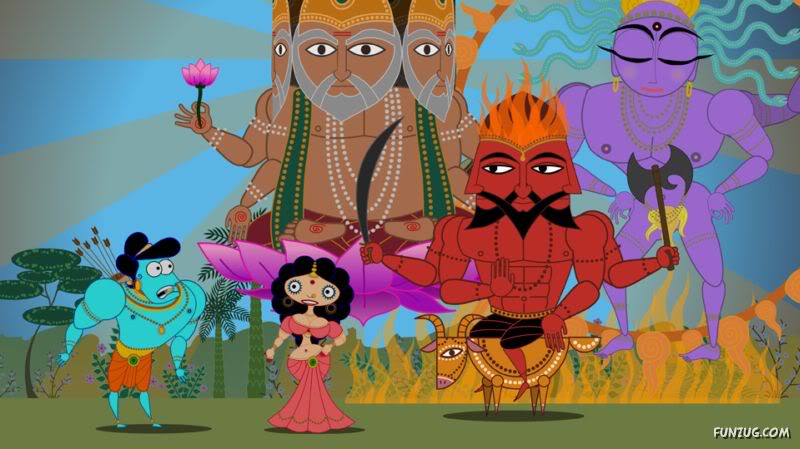
Indian Epic: Ramayana

The Ramayana
(Sanskrit: रामायण, Rāmāyaṇa, IPA: [rɑːˈmɑːjəɳə] ?) 
is an ancient Sanskrit epic. It is ascribed to the Hindu sage Valmiki and forms an important part of the Hindu canon (smṛti), considered to be itihāsa. The Ramayana is one of the two great epics of India, the other being the Mahabharata. It depicts the duties of relationships, portraying ideal characters like the ideal father, ideal servant, the ideal brother, the ideal wife and the ideal king.The name Ramayana is a tatpurusha compound of Rāma and ayana ("going, advancing"), translating to "Rama's Journey". The Ramayana consists of 24,000 verses in seven books (kāṇḍas) and 500 cantos (sargas), and tells the story of Rama (an avatar of the Hindu preserver-God Vishnu), whose wife Sita is abducted by the king of Lanka, Ravana. Thematically, the Ramayana explores human values and the concept of dharma.
Ramayana was written (in Sanskrit) about two thousand years earlier to Mahabharata (the two major Sanskrit epics of ancient India) and some characters of Ramayana presents new equations of relations in Mahabharat.
All Ram-Ravana, Arjun-Karan, Bheem-Duryodhan, Dropadi, Seeta, Shikhandi and Bheesham are present in all human hearts and that's their stage of performance too.


# above cartoon pictures thankfully shared from; http://kketish.blogspot.in/2009/03/ramayana-cartoon-images.html
# cartoon pictures are based on a movie; http://en.wikipedia.org/wiki/Sita_Sings_the_Blues
# link for more detail about Ramayana: http://en.wikipedia.org/wiki/Ramayana